
[EP-43] What to do when staghorn ferns grow beyond the planting board? Real-life experiences of two Thai staghorn fern breeders, Nook and CK Pavilion.


"Your planting board is so beautiful, I still can't find a single plant that matches it."
The person who made this joke was Mr. Nook, a staghorn fern breeder in Thailand.
He has cultivated staghorn ferns for many years, collected native Thai species, and exchanged ideas with collectors around the world.
A set of ROK planting boards can actually make a seasoned grower look back at the plants in their hands.

This article will discuss:
Why do staghorn ferns always seem to run out of a planting board eventually?
Common methods of mounting fern fern baskets in Thailand, and the problems caused by high humidity.
The original words of two Thai breeders, Mr. Nook and CK_Pavilion: one starts from the limitations of materials, and the other starts from the natural form of plants.
Before borrowing the board-mounting methods of players from other countries, ask yourself these three questions.
I brought ROK to Thailand through a Reels video.
Living in Hong Kong, I once made a Reels video about ROK.
This is a set of staghorn fern planting boards designed by the Taiwanese brand Good Good Goods, which can be spliced and expanded.
Later, Reels was favored by the algorithm and reached Thailand, where it was seen by two staghorn fern breeders, Mr. Nook and CK_Pavilion.
After contacting the Good Good Goods team, the sample was sent to them.

After the two senior colleagues had each tried it, I asked them a question that I had never been able to figure out:
What do you do when the staghorn fern grows bigger and bigger than the original board?
Their answers were much more insightful than I had expected.
However, before reading the answer, we need to figure out why there aren't enough boards.
Why do staghorn ferns always run out of boards eventually?

I first noticed it on a very ordinary morning when I was watering the plants.
In the second growing season of that staghorn fern on the board, the lateral buds and vegetative leaves had already covered the edge of the board, with the leaves folding up at one corner outside the board.
The wooden planks also cracked due to the fluctuating indoor temperature and humidity in Hong Kong; they were almost moldy. The planks gave way before the plants could even withstand the strain.
My immediate thought was to choose a smaller board. After examining each leaf closely, I realized the plant was doing the same thing all along.
The round leaves that grow close to the substrate of the staghorn fern (Platycerium) are called vegetative leaves or basal covering leaves.
New nutrient leaves will overlap the old leaves, wrapping outwards to support the roots; after the old leaves turn brown and become papery, they still protect the roots, retain water and collect organic matter, so they should not be peeled off.
Some varieties, such as the dichotomous staghorn fern (P. bifurcatum), will also produce lateral buds from the root tips.
Wherever the roots go, buds will sprout there; they are commonly seen on the edges and backs of the industrial lamina.
Each new leaf and each side shoot needs a fresh surface. When the slab is used up, it means the plant is growing well.
The question is, what options do you have when there aren't enough boards? The answer is quite different in Thailand.
What kind of mounting board is commonly used in Thai staghorn fern rings?
If you ask in Thailand, "On what does the staghorn fern grow?", the first answer might surprise Hong Kong enthusiasts: a plastic pot.
Both breeders mentioned this point. Mr. Nook said:
"In Thailand, the most common practice is to use a simple plastic basin."

For larger plants, growers typically use pine planks, standard wooden boards, or simply attach them to living trees. These are traditional methods that prioritize functionality and pay less attention to aesthetics or deliberate design.
Prioritizing functionality sounds pragmatic. The cost, however, remains to be seen.

"Durability is a big problem in Thailand. Traditional wooden planks often rot and mold in high humidity environments, and over time they can also be infested with insects."
CK also said that he had "experienced these problems to varying degrees," including rot, mold, and insufficient board size.
Reading this reminded me of that broken plank in Hong Kong.
The problems caused by humidity are almost identical in Hong Kong and Thailand.
However, the two breeders dealt with these troubles in completely different ways.
Mr. Nook: Finding a way for plants within limited resources.
Mr. Nook's story begins with a very "Thai" staghorn fern.
His introduction to the hobby was through the staghorn fern (P. holttumii).
This is a large, single-bud variety native to Southeast Asia and Thailand, with tall, upright vegetative leaves that are deeply lobed at the top like a crown.
What attracts Nook is the species’ growth pattern in the wild and its excellent adaptability to urban environments.
But what kept him planting was people.
"Exchanges with local Thai collectors have created a space for sharing experiences and debating ideas. Over time, this close-knit community has expanded to include international growers."
When asked what to do with the plants after they grow bigger, his answer was very frank:
"Many times, when plants grow larger than their original enclosure, we simply can't find a pot or board big enough to accommodate them. So what I usually do is let the plant adapt and struggle in the limited pot, or directly fix it to a real tree so that it has space to grow naturally."
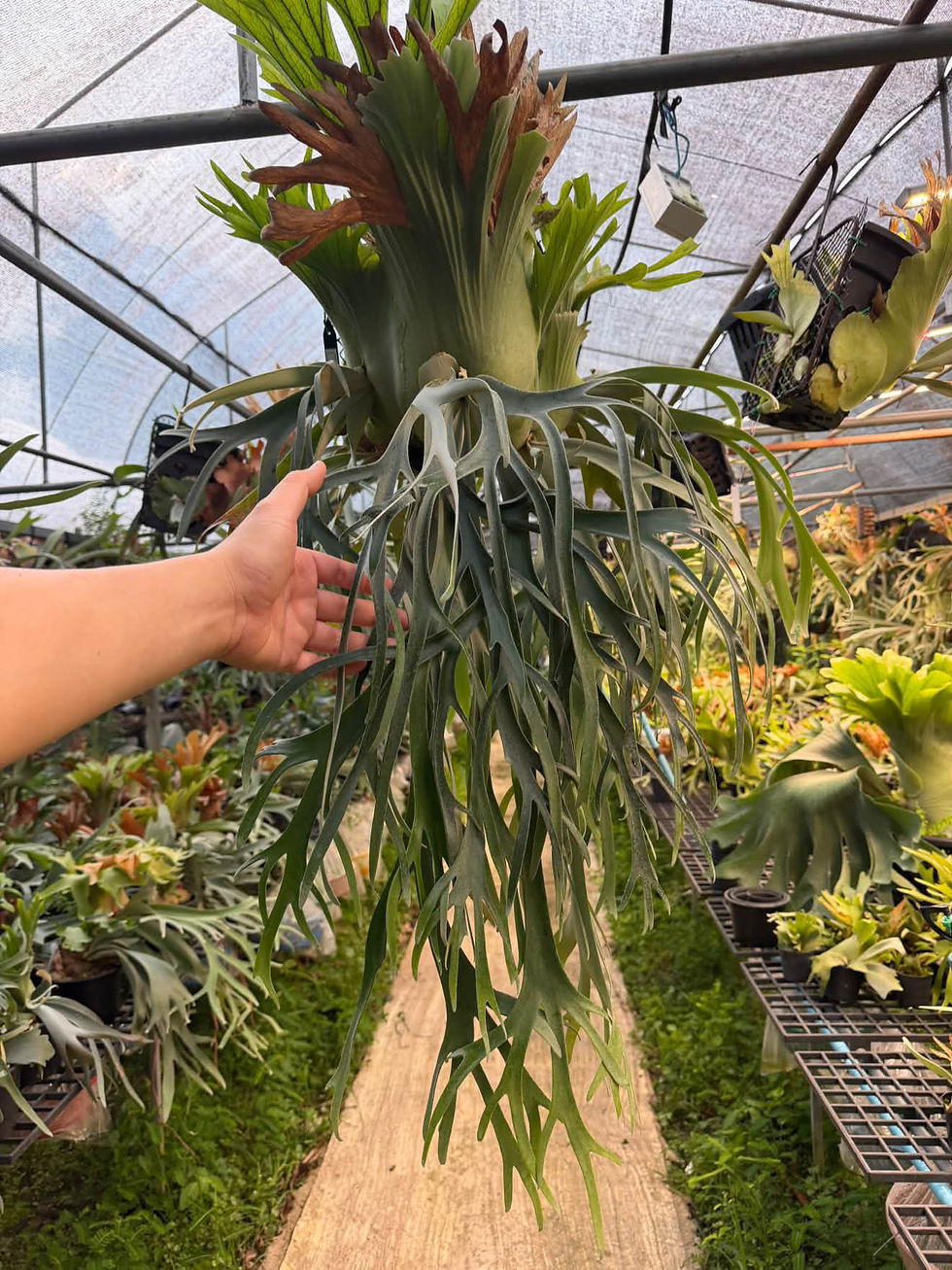
With a small garden and limited equipment, borrowing a real tree is the most practical solution.
So when he first connected the ROK pieces one by one, his reaction was particularly direct:
"As a guy, using ROK feels a lot like playing with LEGO: you can keep customizing and expanding the planting board, increasing the size as the ferns grow."
He added that the design "elevates fern collecting to a creative expression," allowing growers to assemble it in their own style. "This fun and autonomy is exactly why I wanted to try it out and share it with my audience."

For a player who is used to making do with limitations, the word "freedom" carries real weight.
That opening joke is actually true: up to the time of the visit,
Mr. Nook hasn't planted any plants on ROK yet. He's still waiting for one that's worthy of him.
Nook also said something that wasn't entirely favorable to ROK, but I think it's worth noting:
"Natural materials such as wood will gradually deteriorate due to humidity, mold, pests, and sun exposure; on the other hand, plastics will also age and decompose under long-term ultraviolet radiation."
Every material has its own lifespan. This reminder made me even more certain that the choice between indoor and outdoor materials must be made separately.
The same sample box was sent to CK, but the outcome was completely different.
CK_Pavilion: Prevent the container from determining the shape of the plant.
CK's encounter with the staghorn fern began with a name.
"I first discovered the staghorn fern while walking in Chatuchak Market in Bangkok. What initially attracted my attention was actually its name, Platycerium. When I saw the plant itself, I felt that it had a very unique and fascinating quality."
What truly kept him there was his understanding of "growing well":
"Not everyone can bring out the full potential of the same plant. For me, the process of discovering the unique form and personality of each plant is what makes the staghorn fern so fascinating."
This statement explains why he doesn't use plastic basins. The most common practice in Thailand, in his view, is missing one thing:
"In nature, staghorn ferns naturally attach themselves to trees and other surfaces, rather than growing in round containers. I don't want the container to define the shape of the plant; I want the plant itself to be the protagonist."
So when the plants grow bigger, he upgrades the growing medium and the planting board, replacing the larger plants with larger natural wooden boards.
When using timber, he prefers durable, rot-resistant hardwoods and also considers ventilation and humidity.
His assessment of traditional practices was fair:
"Traditional board-laying methods can work well, but the materials need to be selected with the long-term growth of the plants in mind. The more we understand the environment and the materials we use, the lower the likelihood of encountering problems in the future."
After receiving ROK, CK used four pieces of the puzzle to mount a staghorn fern and even filmed a video.
He said this made him rethink support systems: they "can be designed to adapt to plants."
"And the way we choose to plant and display it."
As for why he was willing to share, his reasons were very much in line with the sensibilities of a grower:
"I believe the best way to introduce something new is to use it yourself first. I hope my audience can see ROK from the perspective of a true grower, rather than simply as a product being promoted. Sharing it is also a way to start a dialogue with other growers."

Why are two types of growers facing the same question?
At this point, you might think the two people are talking about two unrelated things.
Mr. Nook talks about restrictions and freedom, like a player getting started at a workbench;
CK talks about natural forms and patience, like a curator setting up an exhibition.
But CK's statement connects the two answers:
"Growers in Thailand, Taiwan, Japan, and other countries may use very different materials and techniques, but the fundamental challenge is the same: the plants keep growing, and the support system must keep up with them."
My judgment is that whether a board-up method is good or not depends on which set of restrictions it responds to.
In places with trees and outdoor space, borrowing trees is a reasonable solution.
If you can buy durable hardwood and there is good ventilation, a large plank can last for many years.
People living indoors in Hong Kong with only one wall and one air conditioner might need a support structure that can be gradually expanded and is resistant to moisture. Each of the three answers is valid because they address different conditions.
The most useful aspect of cross-border communication lies here:
First, understand the conditions under which other people's methods originated, and then assess your own conditions.
Before changing the substrate, look at the plants first, then look at yourself.
So, let's go back to that wall in your house.
First, look at the plants: Pay attention to three areas when watering.
Has the outermost edge of the nutrient leaf touched or flipped over the edge of the board?
Are lateral buds emerging from the edge or back of the stalk? (This step can be skipped for single-bud varieties such as P. holttumii and P. grande, which do not produce lateral buds.)
Gently hold the base of the plant; does it feel loose? (Plants that have just been placed on the board are not yet firmly anchored.) If there is also a sour smell or the base is blackened and soft, treat the rotten parts first.
If he meets two out of three criteria, I will prepare more room for him. This is my experience-based judgment, not a research conclusion.
Looking at yourself: Before borrowing someone else's method, ask yourself three questions.
Should my plants be indoors or outdoors?
Is the humidity, sunlight, and ventilation where I am the same as theirs?
Can I buy and take care of the materials they use?
When starting, growers often use a whole piece of dough:
The old boards are not removed; they are fixed to a larger support surface along with the plants.
Fill the gaps with new sphagnum moss, allowing the roots and new vegetative leaves to grow outwards on their own.
Dwarf staghorn fern seedlings can also be planted using modular planting boards like ROK with interlocking joints.
A 3-piece set is suitable for seedlings that are about 2 to 3 inches in size, and a 5-piece set is suitable for seedlings that are about 3 to 4 inches in size. You can add more pieces later.
Larger varieties are beyond this range in weight and size, so using a larger, whole board for the surface would be more stable.

Frequently Asked Questions (FAQ)
Does the staghorn fern (P. holttumii) produce lateral buds?
No. The Heqimei staghorn fern is a single-bud variety, mainly growing as a single plant. When observing the shedding signs, look at the vegetative leaves and roots.
Should the brown vegetative leaves of the staghorn fern be cut off?
No need. The brown nutrient leaves are still protecting the roots, retaining water, and collecting organic matter; only the leaf that is obviously rotten needs to be removed.
Do you always have to remove the old staghorn fern slab when replacing it?
Not necessarily. Adding a whole sheet of sphagnum moss can preserve the existing attachment of plants; only when the old sphagnum moss becomes sour and smelly or the old board is broken do the damaged parts need to be treated first.
Conclusion | A single board, used to make demands on plants
Going back to that joke at the beginning. At the end of the interview, Mr. Nook added an extra paragraph:
"Your idea inspired me to improve the quality of the plants in the garden because we have many restrictions in Thailand."

Nook showed me another kind of power in objects:
A well-designed object can, in turn, raise the grower's standards for plants.
The two breeders did not provide a standard answer because there is no standard answer to this question.
But one thing is certain: plants don't stay on the day you put them on the board.
He will keep growing, and the way we support him is worth growing up with him.
What kind of board is your staghorn fern on now? Is it tree fern, plank, or hasn't been boarded yet?
Feel free to leave a comment and let me know.
References
Online text interview with Mr. Nook and CK_Pavilion (September 2026, original English text translated by Zhiwu)
Taipei Botanical Garden: He Qimei's Staghorn Fern (Platycerium holttumii)
Wisconsin Horticulture Extension: Staghorn Fern, Platycerium bifurcatum
UF/IFAS EDIS: Staghorn Ferns at a Glance
Richards et al. 1983, American Journal of Botany

![[Ep-32] Winter Foliage Plant Care Essentials](https://static.wixstatic.com/media/1bdabd_008aec3c75a343439363620216e6a05b~mv2.png/v1/fill/w_980,h_980,al_c,q_90,usm_0.66_1.00_0.01,enc_avif,quality_auto/1bdabd_008aec3c75a343439363620216e6a05b~mv2.png)
![[Ep-31] Vintage-Style Plant LED Light — TSKUYOMI 10W AKADAMACHAN MODEL](https://static.wixstatic.com/media/1bdabd_5b992266ad524aa6b9b911de672614ac~mv2.jpg/v1/fill/w_800,h_800,al_c,q_85,enc_avif,quality_auto/1bdabd_5b992266ad524aa6b9b911de672614ac~mv2.jpg)
Comments